In today’s world, the generation of waste is inevitable, and collecting waste is a vital issue to maintain personal and social health. For this reason, garbage bags can be mentioned as one of the daily needs of people to collect garbage. For this purpose, setting up a garbage bag production line for waste production is necessary and profitable.
Raw materials for the production of garbage bags
To produce garbage bags from raw materials or raw materials, you need to use polymer materials, which are produced in petrochemical industries in the country. The polymer used in making garbage bags is polyethylene, which is used in light, heavy, linear, and film types depending on the type, thickness, and multi-layers of the garbage bag.
The important rule for preparing the type of polymer used is that first we determine the specifications of our own production product, what we want to produce and with what specifications, then we purchase raw materials based on the combination of materials and the existing formula for this information. .
For example, in the production of colored garbage bags, the color masterbatch is used in the raw material composition to color the product, and the choice of color will be different depending on the order or work process. Also, in order to produce degradable garbage bags, we will need to use exo-degradable additives. These added oxidizing materials in biodegradable plastic bags cause the plastic to break down faster when exposed to light and air, which is actually fragmentation into small pieces.
Devices for the production of garbage bags
The garbage bag production line generally includes the following devices:
Nylon production machine: The main machine used in this production line is the nylon production machine. This machine is actually an extrusion machine that has a mold and the type of mold will be different according to the dimensions of the manufactured product.
Usually, the width of the produced nylons is between 80 and 100 cm, but some machines have the ability to produce a width of 120 cm.
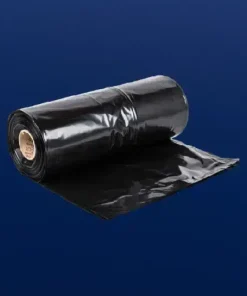
After the nylon is formed, the manufactured product is gathered into a roll (like fabric arches) and then sent to the next machines for sewing and cutting.
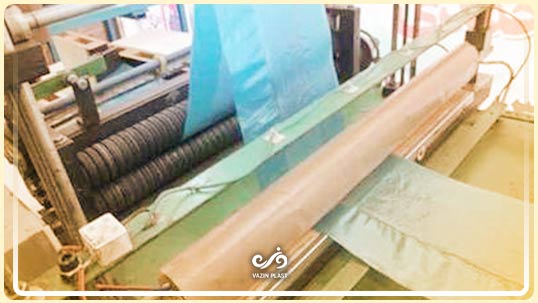
Garbage bag sewing machine: Nylon bag sewing machines are thermal devices in the form that two hot narrow edges are placed on two layers of nylon and the sewing operation is performed by a press.
The size of the machine can be different depending on the width of the produced nylons. Due to the sensitivity in the process of sewing and pressing, high-quality devices must be used so that users do not have problems such as opening or leaking garbage faucets.
The most high-quality type of sewing machine is the star stitch type, which significantly reduces the possibility of tearing and leakage at the sewing site.
Garbage bag perforating machine: This machine does not work in the production of all types of garbage bags and is only used in the production line of Roli and London garbage bags. Single bags do not need to be perforated, but roll bags must be perforated for easy separation
. The better the perforation on the bags, the less likely the bag will tear during separation. This machine is available in two types, automatic and semi-automatic. The semi-automatic type has an operator, but it has a higher perforating speed than the automatic type. Although the automatic type has a lower production speed, it is more accurate and safer and does not require an operator.
Garbage bag production process
To produce garbage bags, polyethylene granules are first poured into the hopper of the machine.
Then these granules enter the extruder machine; A device that melts granules by heating them at a temperature of 365 to 465 degrees Fahrenheit.
Then the molten material passes through the mold. When the material passes through the mold, the air pump or compressor creates a balloon state in the bags by producing high pressure air and prevents them from sticking together.
The produced plastic bubble is gradually cooled and with the help of rollers it turns into a smooth tube with a length of several meters and a very small thickness called film.
The produced plastic film is placed in the cutting machine and its cutting and sewing operations are performed. Finally, the manufactured product is packaged and ready for sale.
Different uses of garbage bags
Although all garbage bags are produced with the purpose of collecting waste, it is interesting to know that these bags can be divided according to the purpose and the place they are to be used:
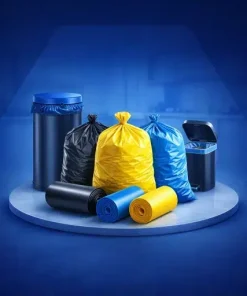
Household garbage bag: This type of bag is the most common and widely used type of garbage bag.In domestic use, some wastes are wet and some are dry. Therefore, users can avoid using different bags for proper separation of waste. For example, for dry waste, use bags with a reasonable price and less thickness, and for wet waste, use better quality and thicker bags.
Organizational and office waste bags: due to the nature of office and organization wastes being different from household wastes and often consisting of dry, small and small objects and materials, the waste bags for these places are also different. These bags often have a small thickness and are thin and have smaller dimensions than household bags, so that they can be filled and replaced faster and prevent the pollution of public environments.
Hospital waste bag: One of the most important places of waste production are health and treatment centers. To separate the waste in hospital sources, the waste is divided into three types: infectious, non-infectious and destruction or autoclave, and different bags are used for each.
The non-sterile garbage bag is used to accumulate dry and ordinary garbage that does not have hospital contamination. Infectious waste bags are used for waste with infectious and biological contamination, which has the possibility of transmission of disease and infection. A special garbage bag is also used to quickly destroy some infectious and dangerous laboratory waste. Each of these applications is represented by its own color.
Production sample of waste bag production, printing and sewing machines



 العربية
 Kurdish
 فارسی
فارسی Русский